
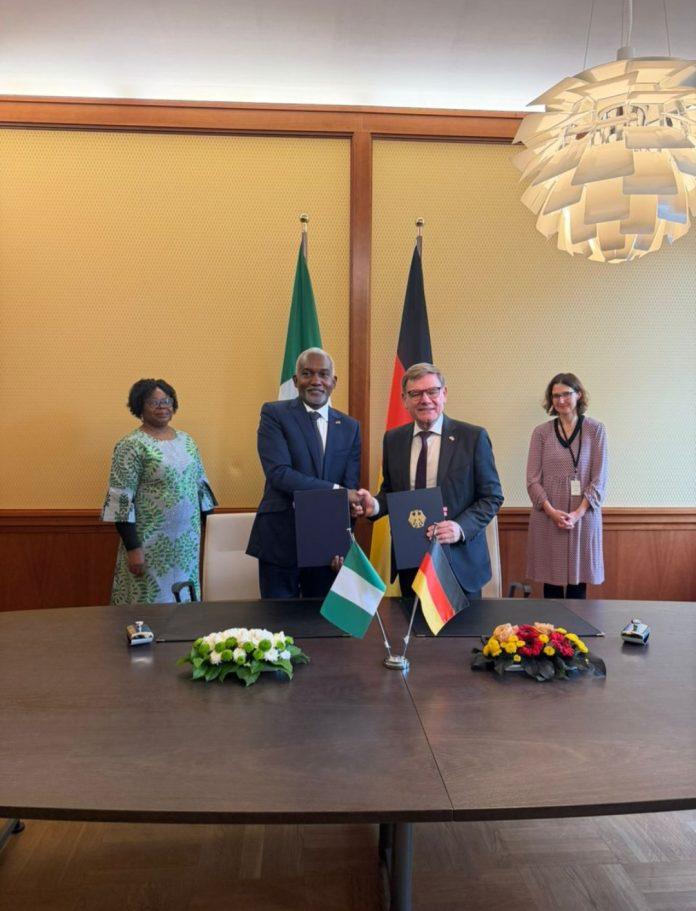
Nigeria and Germany have renewed their commitment to deepen cooperation in key areas such as energy, security, trade, migration, and culture under the Nigeria–Germany Bi-National Commission framework.
The Minister of Foreign Affairs, Ambassador Yusuf Maitama Tuggar, met with his German counterpart, Johann Wadephul, in Berlin as both countries marked 65 years of diplomatic relations.
Ambassador Tuggar, who conveyed greetings from President Bola Tinubu, praised Germany for its “enduring friendship and constructive partnership” in supporting Nigeria’s development goals. He highlighted Nigeria’s balanced approach to energy transition, saying the country will “leverage gas as a transition fuel while scaling up renewables.”
Both sides agreed to strengthen collaboration on security, including intelligence sharing, cybersecurity, and border management through the German Technical Advisory Group. Tuggar also urged the European Union to take a firmer stance against proscribed groups using its territories for incitement or illegal financing.
Trade between Nigeria and Germany reached €3 billion in 2024, making Germany Nigeria’s second-largest European trading partner. Tuggar called for greater diversification of trade beyond oil and gas, with focus on automotive assembly, ICT, manufacturing, and agriculture. He added that Nigeria’s removal from the Financial Action Task Force (FATF) Grey List has improved investor confidence.
The two countries also praised ongoing cooperation on migration and skills development, including the Talent Partnerships and SUSTAIN Project. Nigeria proposed expanding these initiatives to include ICT, engineering, and healthcare training.
During the meeting, both ministers reviewed progress on the Presidential Power Initiative led by Siemens Energy and the Green Guarantee Group, which aim to boost investment in renewable energy and climate-resilient infrastructure.
Ambassador Tuggar described Nigeria–Germany relations as “a cornerstone of our engagement with Europe and the wider global community.”