
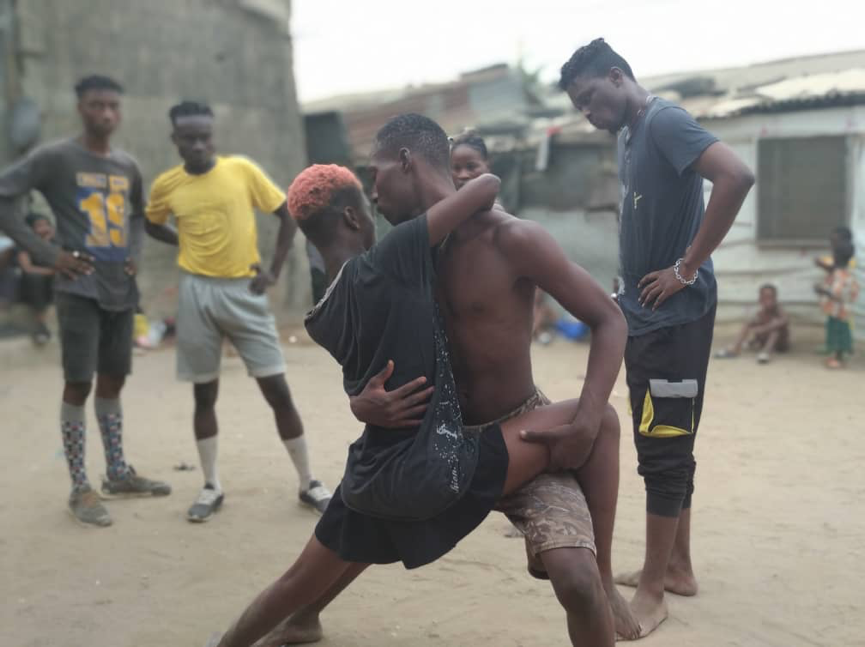
Sitting uneasily between mainland Lagos and Victoria Island, just before the Third Mainland Bridge, lies Mosafejo Oworonshoki, a densely populated waterfront community of fishermen, petty trading women and out of school children.
Ozegbe Sunday Obiajulu has lived here all his life. The son of lower middle class parents, he discovered dance in secondary school and never let it go. Today, he dedicates himself to helping young people channel their energy into something positive by teaching dance classes and staging exhibitions within the community.

“Presently we have have a very strong dance community in Oworonshoki where dancers have been able to accomplish interesting feats by channelling their youthful energy into dance and the Arts in General. I believe we can do more by focusing on primary and secondary schools in Oworonshoki,” Sunday says.
Known to friends as VALU, he chose not to pursue a university degree, convinced that a life in dance offered him a clearer future. His sister, by contrast, is a decorated chess champion at the University of Lagos, a detail he shares without regret.
Life in Mosafejo
Access to education remains one of Mosafejo’s deepest challenges. The community has only one public primary school and one secondary school to serve its large population of children. Many who live closer to the waterfront are so cut off by distance and lack of infrastructure that makeshift nursery and primary schools have become the default option.
One such school stands on Lone Street, Mosafejo. It is a church building converted into a general classroom that holds pupils of all ages and levels under one roof. With Oworonshoki’s population estimated at about 665,998 under Kosofe Local Government, the gaps in basic education are hard to ignore.

At Folu Nursery School, the realities are similar. The headteacher, Ms Folu, has struggled to run the school since she started it three years ago. Space is tight, classrooms are improvised and resources barely stretch. Attendance is inconsistent because many parents cannot afford the N4000 fees.
Seeing out of school children loitering around the community or riding in fishing boats is common. The consequences show up in rising crime levels.

VALU recalls a conversation that underscored this. “The former Divisional Police Officer for Oworonshoki in 2019 told me one of the major reasons for the increase in cult activities in Oworonshoki was because young kids from as early as primary 4 were been initiated into gangs.”
His dance classes are not a perfect solution. They are a temporary intervention in a place where the problems demand a strategic and well resourced response. Still, they offer something meaningful in the moment.
“When I go to a school and volunteer to teach dance, even the hardest or most stubborn of the kids won’t refuse a dance class, why? Because it’s Fun. So I get their attention with dance, then I slowly encourage them towards taking their academic pursuits seriously. If they attend 3 hours of my dance training after school, where will they find the strength to go meet up with again afterwards? They will go home sleep and go to school the next Day. Dance is fun and the young people in this neighbourhood need a space to express all that energy.”
Beyond the classes, VALU dreams of building a community arts center near the waterfront. Still, he fears what may happen if the government moves to clear the area. He has watched other waterfront communities like Otodo Gbame and Takwa Bay disappear through forced evictions. He worries that Oworonshoki could be next.