
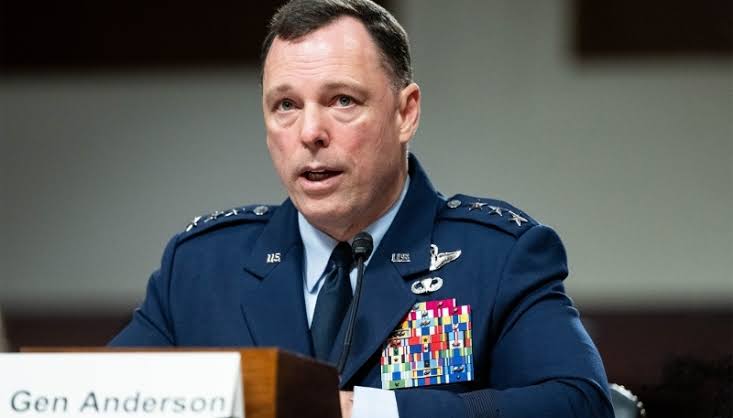
The commander of United States Africa Command AFRICOM has presented a new vision for deeper cooperation with African militaries, linking security partnerships to economic development and regional stability.
But while U.S. officials describe the approach as collaborative and “partner-led,” the strategy also raises familiar questions about sovereignty, dependency and whose interests ultimately shape the continent’s security agenda.
Speaking during a digital press briefing hosted by the U.S. State Department’s Africa Regional Media Hub, AFRICOM commander Dagvin R. M. Anderson and Command Senior Enlisted Leader Garric M. Banfield said Washington is working more closely with African governments to confront terrorism, strengthen maritime security and support what they described as the “confluence” of security and economic growth.
Over the past five months, Anderson said he has visited 11 African countries and recently traveled to Ethiopia, Kenya and Djibouti alongside U.S. diplomatic leaders. He highlighted joint investments such as runway upgrades at Kenya’s Manda Bay and meetings with the African Union, framing them as examples of how security cooperation can unlock trade and development.
“Security leads to stability, and stability creates opportunities for investment,” Anderson said.
For many African observers, however, that formula cuts both ways. Infrastructure tied to foreign military cooperation can also deepen external influence over strategic corridors, ports and airspace. Critics say it is important to ask not only who benefits from stability, but who controls the terms of that stability.
Much of the briefing focused on counterterrorism, with Anderson warning that ISIS- and al-Qaida-linked groups continue to expand across parts of the Sahel, the Horn of Africa and coastal West Africa.
He pointed to closer collaboration with Nigeria, as well as training hubs under development in Morocco and Tunisia, as signs of growing regional capacity.
AFRICOM also confirmed a slate of multinational exercises this year, including African Lion in Morocco, Cutlass Express in Mozambique, Justified Accord in Kenya and Flintlock, a special operations exercise hosted by Côte d’Ivoire with activities in Libya.
The drills bring together dozens of African and non-African forces for joint training on counterterrorism, maritime security and anti-smuggling operations.
Supporters argue these exercises improve interoperability and preparedness. Yet some security analysts caution that heavy reliance on foreign-led training risks reinforcing a model where African militaries depend on outside powers for equipment, intelligence and logistics rather than building fully autonomous systems under regional control.
Responding to questions about increased U.S. airstrikes in Somalia, Anderson described them as targeted actions requested by Somali partners, saying the strikes helped local forces push ISIS militants out of strongholds in the Golis Mountains. He characterized the operations as “enabling support,” alongside intelligence, surveillance and resupply.
Still, air campaigns carried out by foreign powers remain politically sensitive across the continent.
Civil society groups have long raised concerns about transparency, civilian harm and the precedent of external militaries conducting lethal operations within African borders. For Africans, the deeper issue is capacity. If security gains rely heavily on foreign airpower and surveillance, how sustainable are they when those partners eventually scale back or shift priorities?
Throughout the briefing, AFRICOM leaders emphasized “mutual interests” and “shared responsibility.” Yet the structure of the relationship underscores an imbalance: AFRICOM remains an American command, headquartered outside the continent, with funding, intelligence and strategic direction set in Washington. That reality complicates claims of equal partnership.
From a Pan-African perspective, cooperation with external actors is not inherently problematic. Many governments welcome training, equipment and technical expertise. But the long-term goal for the continent has consistently been self-reliance through African-led institutions and regional solutions.
The challenge is ensuring that security assistance strengthens those institutions rather than overshadowing them.
As extremist threats, piracy and cross-border crime continue to test fragile states, African governments will likely keep engaging partners such as the United States. The question is how to balance that engagement with sovereignty and accountability. If stability is to translate into real prosperity for African citizens, security strategies must be guided first by local priorities, not global power competition.
AFRICOM’s renewed outreach signals that Washington intends to remain deeply involved in Africa’s security landscape. Whether that involvement ultimately empowers African leadership or entrenches dependency will depend on how firmly the continent sets its own terms.